
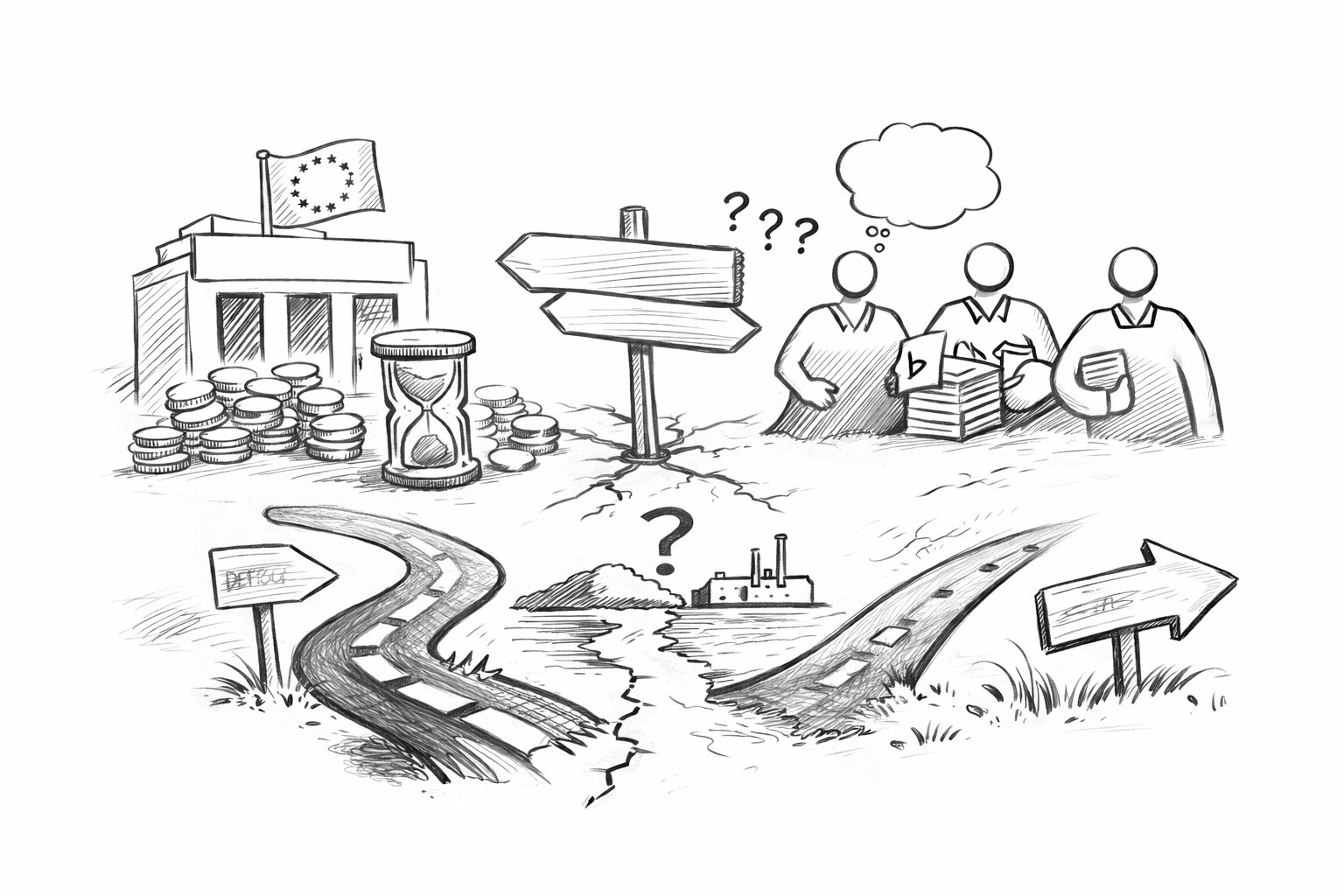
The Data Spaces Support Centre (DSSC), which is supposed to offer burgeoning data spaces a blueprint by which they can build themselves up, has a series of ‘building blocks’ that give organisational and business advice. It’s more briefing than blueprint, as it provides a wide array of options. Imagine an architect giving a blueprint to a builder that provides a series of options that could lead to either a skyscraper or a cabin by the lake, and you can imagine why calling the DSSC materials a blueprint is a bit of a misnomer.
Nonetheless, within the operational options that the DSSC blueprint provides, does it guide a data space to a clear pathway to build something operational and financially sustainable? For some of the potential options it provides, I would answer no. In fact, the organisational form of many data space initiatives—particularly those funded by the European Commission under Horizon Europe rules—make it particularly difficult to create a sustainable business model.
The problem for Horizon Europe funded data spaces is two-fold. First, Horizon Europe projects for data spaces are generally run under consortia agreements that are temporary in nature. The primary goal is not to make the data space a profitable or financially sustainable entity, but rather to further the goals of each entity involved in the project. Financial sustainability is an output (as symbolized by a work package) rather than a core goal.
Second, consortia are generally incapable of writing credible business plans unless there is a partner that is committed to take the assets created and making a business out of it, which needs to include some kind of commitment to future (capital) investment. Otherwise, any ‘sustainability plan’ is nothing more than an academic exercise when partners lack any kind of skin in the game.
The many options for the legal entity
In my last blog post, I mentioned how the DSSC describes different types of (legal) entities that could represent or be the data space. They provide a handy flow chart, which creators can follow to narrow down the options.
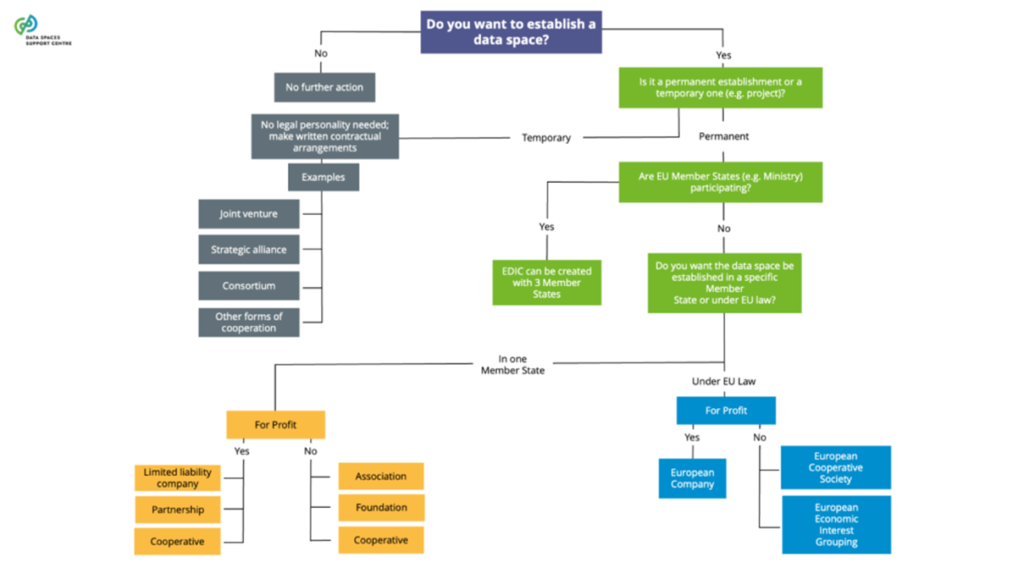
Ignoring the initial yes/no question of whether someone wants to build a data space (I would hope it’s yes if they’re reading the building block), the first question is whether the data space is a temporary or permanent entity. It’s on this distinction that I want to focus, because it helps to explain why data spaces funded by the European Union have such a difficult time sustaining themselves once funding expires.
The Consortium Conundrum
Many of the data spaces that receive Horizon Europe funding are consortia formed from disparate entities that have complementary skills to deliver on the objectives of a call. This is, as the flow chart outlines, a temporary entity that generally lasts as long as the funding from the European Commission is provided. Once the contract ends, so does the consortium agreement. Entities may continue to work with each other, sometimes even on projects of similar scope, but it will be under a new agreement, and not always with the same configuration of partners.
The DSSC is, in fact, a good example of this. The first iteration of the support centre is run by a consortium of organisations that includes research & technology organizations (RTOs), universities, associations, and private consultancies. They co-operate based on a consortium agreement and agree to work on deliverables as promised in a proposal. As DSSC winds down and a second iteration starts up, we see a new consortium with some of the old players, but not all of them, and a few new ones as well. The call changes, and as such, so does the consortium. There is limited organizational consistency between the two versions of the DSSC.
What happened with the DSSC is emblematic of a wider problem affecting many Horizon Europe data‑space consortia. Despite its successes, it also proved unwieldy as the needs of the data-space community shifted from inception to implementation.
This difficulty adjusting is, in fact, a feature of a consortium. They are inclusive and relatively painless to set up, but they can also be cumbersome, with major decisions requiring unanimous consent from diverse partners with different interests. This divergence of interests becomes less and less sustainable as time passes. Agility is not always a feature, particularly when a consortium is made up of many partners.
Consortia lack the organisational integrity to build a credible business model
Because consortia are temporary, project-driven entities, they lack the organisational integrity required to build a credible, long-term business model.
For example, the temporary nature of a consortia agreement raises a question of staff loyalty, and whether decisions are being taken for the good of a future data space’s business model, or whether decisions are being taken in the interests of the individual organisations that make up the consortium. The staff that are working for the data space are not employed by the data space itself, and as such, their loyalties lie with their home organization, and not the data space that they are supposed to represent. This creates, at best, instability, and at worst, conflicting incentives where the overall goals of the members take precedent over the needs of the data space itself.
This lack of organisational integrity can also be seen in how intellectual property is handled. Given that the consortium has no legal form, there is no entity to which intellectual property can be transferred. As such, at best, data spaces created under the auspices of Horizon Europe will get access to materials made available through a creative commons or open source license. They will not, however, have the option of developing commercially protected intellectual property that they can later monetise. This isn’t to say that a business model needs to rely on protected material, but it certainly narrows the business choices that any newly forming data space building on the foundations created by a data space project.
With these burdens weighing on the consortium, it creates a problem for any discussions around a business model.
Writing a good business plan requires skin in the game
Given that the temporary nature of a consortium and the lack of capital investment into any activities of the data space, it is little surprise that business planning that data spaces create—at least those funded by the European Commission under the auspices of Horizon Europe—tend to be theoretical exercises. The business models that they create talk about high-level value propositions that lack quantification. A business plan cannot calculate costs unless it knows the cost base of the organisation that will drive it.
More importantly, given that the consortium is driving a business plan that they will not ultimately execute, they have no incentive to measure risks in a credible manner. Proper market analyses are expensive to execute. As well, to demonstrate that a (theoretical) business plan can be successful, a consortia has every incentive to overestimate benefits and underestimate costs. This is a well-known and well-documented problem in public-private partnerships that use special-purpose vehicles (SPV) to build infrastructure. Ultimately, if bankruptcy comes, the SPV dies, but the founding members remain untouched.
Understanding and feeling risk is an essential element of business planning, creating discipline and forcing specificity on the writers of a business plan. No manager, bank, or investor will provide resources without a credible account of what can be delivered.
Until data-space initiatives adopt permanent legal forms with committed partners and capital investment, data spaces will be likely fail to produce sustainable data spaces. Achieving sustainable data spaces will require rethinking not only architecture and governance, but the very frameworks through which they are initiated.